
Blog
What Is Insomnia? Symptoms, Causes, and How to Sleep Better Naturally

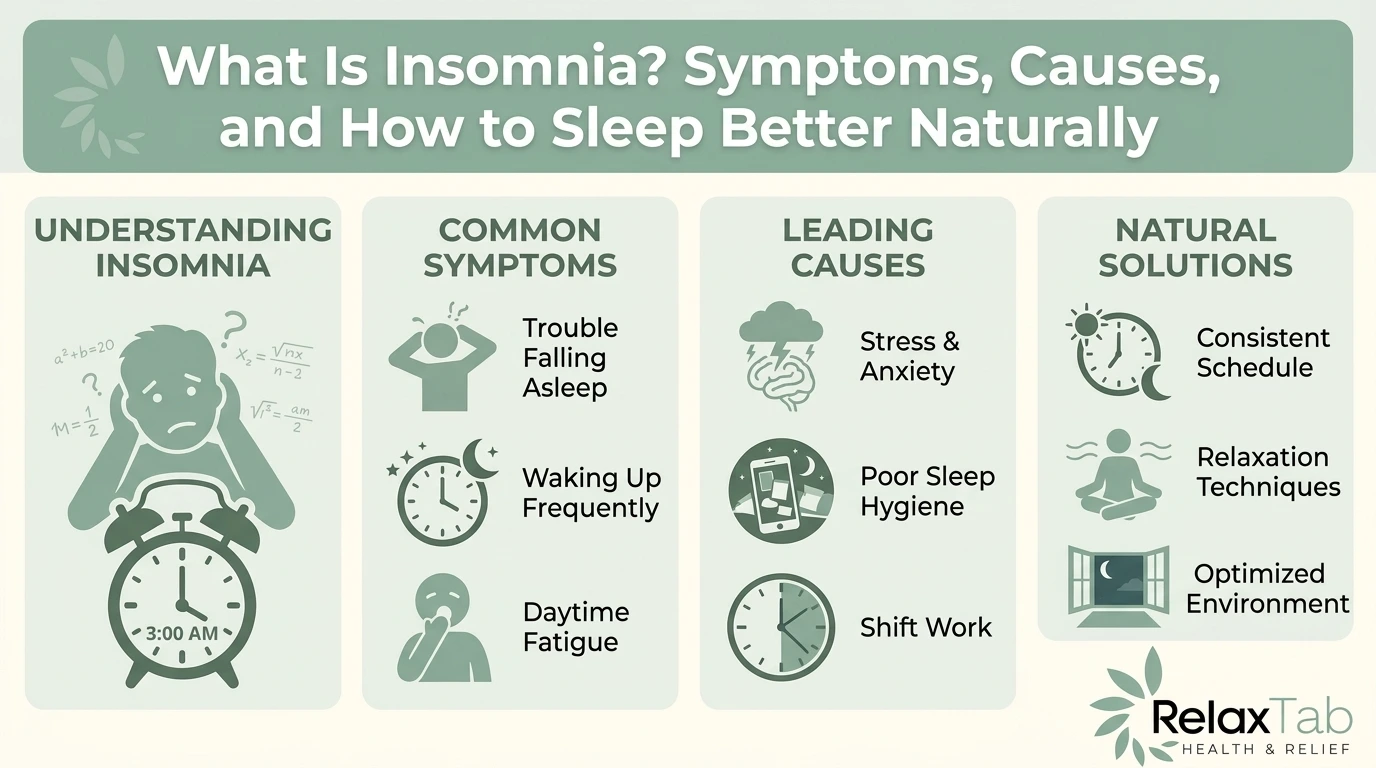
If you’ve spent another night staring at the ceiling doing math about how many hours of sleep you’ll get “if I fall asleep right now,” you already know something’s off. You’re not lazy, weak-willed, or “bad at sleeping” — you’re dealing with a real, common, and treatable condition. Here’s exactly what’s going on, why it happens, and what actually helps.
What Is Insomnia?
Insomnia is a sleep disorder marked by persistent difficulty falling asleep, staying asleep, or waking too early, despite having the opportunity to sleep. It’s the most common sleep complaint worldwide, affecting roughly 1 in 3 adults occasionally and around 10% chronically.
Insomnia isn’t just “a bad night.” It becomes clinically significant when it happens at least three nights a week for a month or longer and starts affecting your energy, mood, or ability to function during the day.
Insomnia is a sleep disorder characterized by trouble falling or staying asleep, or waking up too early and being unable to return to sleep, occurring despite adequate opportunity for rest.
For some people, a doctor may recommend sleeping pills as part of a short-term treatment plan.
Signs of Insomnia You Shouldn’t Ignore
Insomnia shows up differently for everyone, but the core signs are consistent.
Nighttime signs:
- Taking more than 30 minutes to fall asleep
- Waking up multiple times during the night
- Waking up too early and not being able to fall back asleep
- Lying awake “wired but tired”.
Daytime signs:
- Fatigue or low energy despite time in bed
- Difficulty concentrating or remembering things
- Irritability, anxiety, or low mood
- Increased errors or accidents
- Ongoing worry about sleep itself.
If three or more of these sound familiar, and it’s been happening for weeks, it’s worth paying attention to.
How Many Nights a Week Counts as Insomnia?
Sleep specialists generally use a 3 nights per week, for 3+ months threshold to define chronic insomnia. Fewer episodes, or a shorter timeframe, usually points to acute (short-term) insomnia instead.
Causes of Insomnia
Insomnia rarely has one single cause — it’s usually a mix of physical, psychological, and lifestyle factors.
For a deeper look at the common factors behind sleep difficulties, read what causes trouble sleeping.
| Category | Common Causes |
| Psychological | Stress, anxiety, depression, grief, racing thoughts |
| Lifestyle | Irregular sleep schedule, caffeine/alcohol late in the day, screen use before bed, shift work |
| Medical | Chronic pain, acid reflux, asthma, thyroid issues, menopause |
| Environmental | Noise, light, uncomfortable temperature, an unfamiliar bed |
| Medication-related | Certain antidepressants, steroids, stimulants, decongestants |
| Behavioral | Napping too much, using the bed for work, inconsistent wake times |
Is Stress the Number One Cause of Insomnia?
Stress and anxiety are the most frequently reported triggers of insomnia, especially acute insomnia. When your mind is in problem-solving or worry mode, your body’s stress hormone (cortisol) stays elevated, which directly interferes with the ability to relax into sleep.
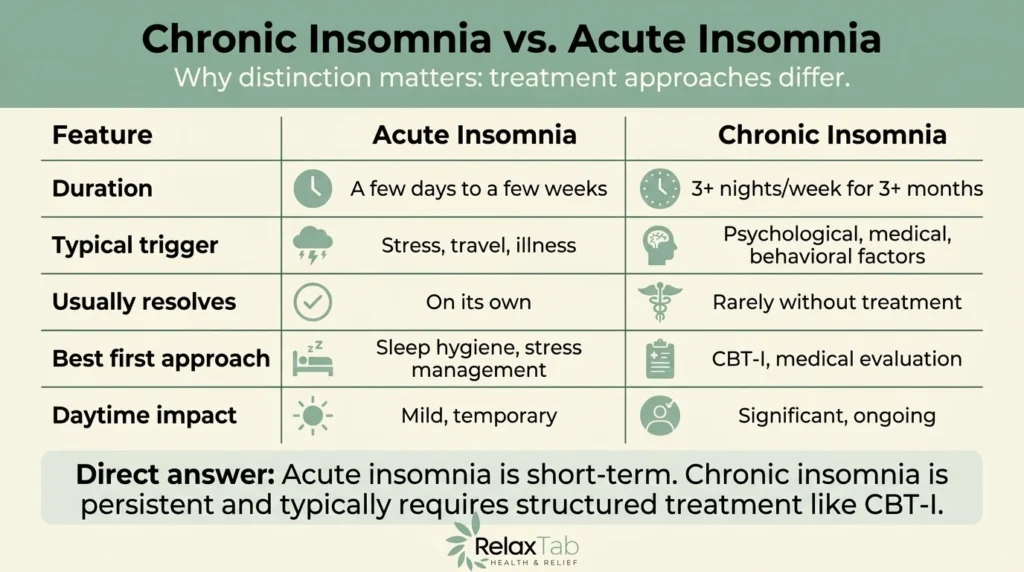
Chronic Insomnia vs. Acute Insomnia
This distinction matters because it changes how you should approach treatment.
| Feature | Acute Insomnia | Chronic Insomnia |
| Duration | A few days to a few weeks | 3+ nights/week for 3+ months |
| Typical trigger | Stress, travel, illness, a big event | Ongoing psychological, medical, or behavioral factors |
| Usually resolves | On its own, once the trigger passes | Rarely resolves without active treatment |
| Best first approach | Sleep hygiene, stress management | CBT-I, medical evaluation, lifestyle changes |
| Daytime impact | Mild, temporary | Significant, ongoing |
Acute insomnia is short-term sleep trouble tied to a specific stressor that usually fades on its own. Chronic insomnia is a persistent pattern lasting three months or more that typically needs a structured treatment approach, such as Cognitive Behavioral Therapy for Insomnia (CBT-I).
Insomnia Symptoms and Causes: How They’re Connected
Here’s the part most people miss: symptoms and causes feed each other. Anxiety causes poor sleep → poor sleep increases anxiety → anxiety makes falling asleep even harder. This is called the “insomnia loop,” and it’s why insomnia can persist long after the original trigger is gone.
Breaking this loop is the actual goal of most effective insomnia treatment — not just “trying harder” to sleep.
How to Improve Sleep Quality Naturally
Before reaching for anything else, these evidence-backed habits are the foundation of good sleep — sleep specialists call this sleep hygiene.
For more practical ways to build healthier nighttime habits, explore these sleep hygiene tips.
The National Heart, Lung, and Blood Institute (NHLBI) provides additional guidance on healthy sleep habits and insomnia treatment.
- Keep a consistent wake time — even on weekends. Your body clock responds to wake time more than bedtime.
- Get morning sunlight within 30–60 minutes of waking to anchor your circadian rhythm.
- Cut caffeine after early afternoon. Caffeine has a half-life of 5–6 hours.
- Limit alcohol close to bedtime — it fragments sleep even if it helps you fall asleep faster.
- Create a wind-down routine — dim lights, no screens, a warm shower, light stretching.
- Keep your bedroom cool, dark, and quiet (ideally 60–67°F / 15–19°C).
- Reserve your bed for sleep and intimacy only — not work, scrolling, or TV.
- Move your body during the day. Regular exercise improves sleep depth, though avoid intense workouts within 2 hours of bed.
Do Natural Supplements Actually Help With Sleep?
Certain nutrients play a supporting role in sleep regulation. For example, magnesium helps relax the nervous system, melatonin signals your body that it’s nighttime, and B12 supports the production of serotonin and melatonin. These aren’t cures for insomnia, but they can support a healthy sleep-wake cycle alongside good habits.
Tips to Fall Asleep Faster Tonight
If you want something you can use right now, try these:
- The 4-7-8 breathing method: Inhale 4 seconds, hold 7, exhale 8. Repeat 4 times.
- Progressive muscle relaxation: Tense and release each muscle group from feet to head.
- The 20-minute rule: If you’re not asleep in 20 minutes, get up, do something calm and dim-lit, then return when sleepy.
- Brain dump journaling: Write down tomorrow’s to-do list before bed to quiet racing thoughts.
- Cool your room down a couple of degrees — a small temperature drop mimics the body’s natural pre-sleep cooling.
Don’t watch the clock. Checking the time repeatedly increases anxiety about not sleeping, which paradoxically keeps you more awake. Turn your clock face away from you.
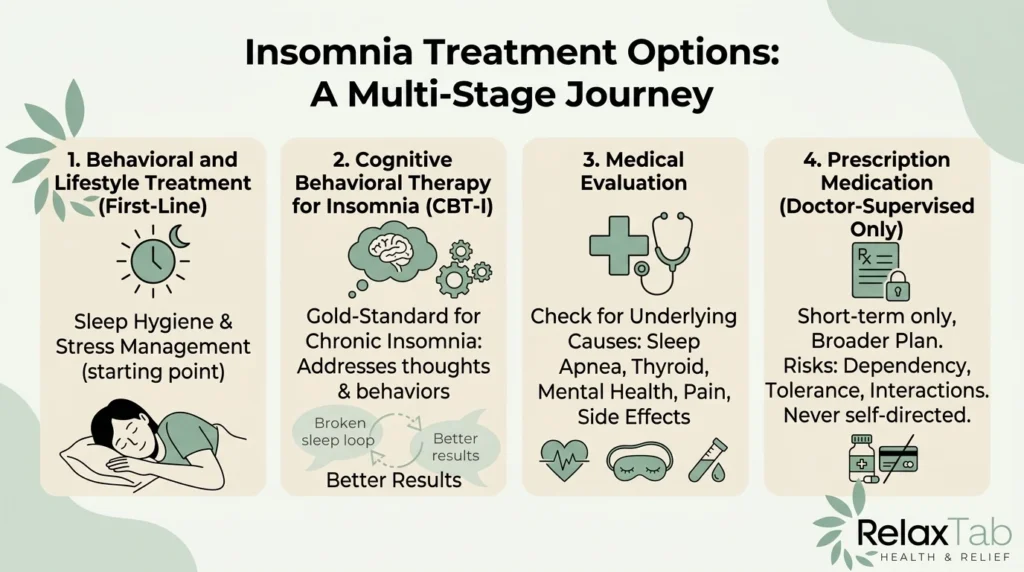
Insomnia Treatment Options
Treatment isn’t one-size-fits-all. It typically progresses through a few stages:
1. Behavioral and Lifestyle Treatment (First-Line)
Sleep hygiene changes and stress management are always the starting point, especially for acute insomnia.
2. Cognitive Behavioral Therapy for Insomnia (CBT-I)
CBT-I is considered the gold-standard, first-line treatment for chronic insomnia by sleep medicine guidelines. It addresses the thoughts and behaviors that keep the insomnia loop going, and has shown better long-term results than medication alone in clinical studies.
3. Medical Evaluation
If insomnia persists, a doctor can check for underlying causes — thyroid issues, sleep apnea, chronic pain, mental health conditions, or medication side effects.
If pain is contributing to sleep problems, a healthcare professional can determine whether appropriate pain management is needed; codeine phosphate is a prescription opioid that requires careful medical supervision.
4. Prescription Medication (Doctor-Supervised Only)
In some cases, a doctor may prescribe short-term sleep medication as part of a broader treatment plan. Clonazepam (Klonopin) is a prescription benzodiazepine that should only be used under the direction and supervision of a qualified healthcare professional. Because these medications (including benzodiazepines and Z-drugs) carry real risks around dependency, tolerance, and interactions, they should only ever be started, monitored, and stopped under a licensed prescriber’s supervision — never self-directed or purchased without a verified prescription.
For detailed information about clonazepam’s uses, warnings, and precautions, see MedlinePlus Drug Information.
Comparison of Treatment Approaches:
| Approach | Best For | Timeframe | Risk Level |
| Sleep hygiene | Mild/acute insomnia | Days to weeks | Very low |
| CBT-I | Chronic insomnia | 6–8 weeks | Very low |
| Relaxation techniques | Anxiety-linked insomnia | Immediate–ongoing | Very low |
| Prescription medication | Severe/short-term, doctor-directed | Days to weeks (short-term) | Moderate–high, requires supervision |
When to See a Doctor
Talk to a healthcare provider if:
- Insomnia lasts longer than 3–4 weeks
- It’s affecting your work, relationships, or safety (e.g., driving)
- You notice loud snoring or gasping (possible sleep apnea)
- You’re relying on alcohol or over-the-counter aids to sleep
- You feel persistently low, anxious, or hopeless.
A doctor can identify underlying causes and, if appropriate, refer you for CBT-I or further evaluation.
FAQs
Q1: What is insomnia in simple terms?
A: Insomnia is ongoing difficulty falling asleep, staying asleep, or waking too early, even when you have the chance to rest — leading to daytime fatigue and reduced functioning.
Q2: What are the main signs of insomnia?
A: Taking over 30 minutes to fall asleep, frequent night waking, early waking, and daytime fatigue, irritability, or trouble concentrating.
Q3: What causes insomnia the most?
A: Stress and anxiety are the most common triggers, though medical conditions, poor sleep habits, and certain medications also play major roles.
Q4: What’s the difference between chronic and acute insomnia?
A: Acute insomnia is short-term and tied to a specific stressor; chronic insomnia occurs 3+ nights weekly for 3+ months and usually needs structured treatment like CBT-I.
Q5: How can I improve my sleep quality naturally?
A: Keep a consistent wake time, get morning sunlight, limit caffeine and alcohol, and build a calming pre-bed routine.
Q6: What is the fastest way to fall asleep?
A: Try the 4-7-8 breathing technique, progressive muscle relaxation, and cooling your room — these calm the nervous system quickly.
Q7: Is insomnia a disease or a symptom?
A: Insomnia can be both: it’s classified as a sleep disorder on its own, but it’s often also a symptom of an underlying stressor, medical issue, or mental health condition.
Q8: Can insomnia go away on its own?
A: Acute insomnia often resolves once the triggering stressor passes. Chronic insomnia usually needs active treatment, as it tends to persist rather than self-resolve.
This article is for general educational purposes and isn’t a substitute for personalized medical advice. If sleep problems are affecting your daily life, please talk to a doctor or a qualified sleep specialist.